Eric Robbins Portfolio

Case Study: Treasury Financial Experience (TFX)

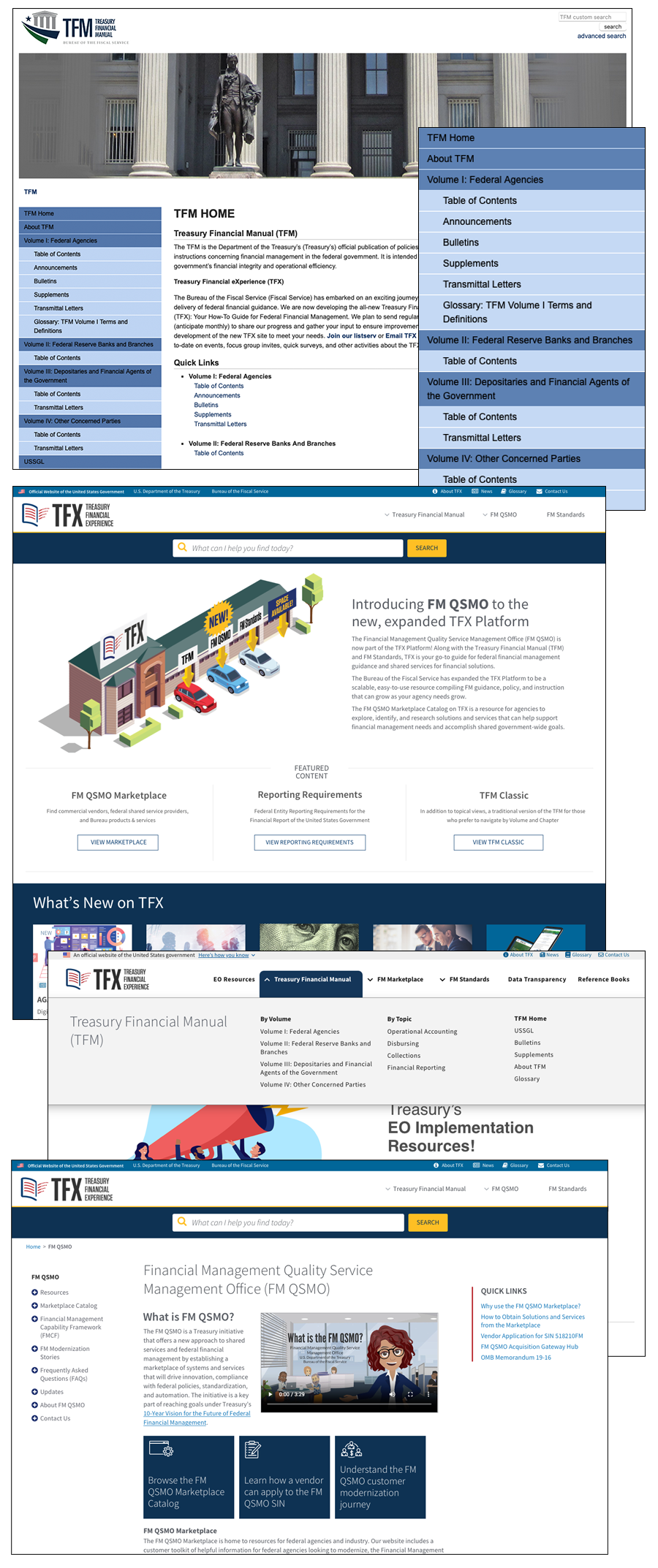
Treasury Financial Experience graphics

My Role: Lead Designer/Digital Transformation Specialist

Challenge

The Treasury Financial Manual (TFM) was originally a series of binders outlining how agencies conduct business with the Federal Government. When it was put online, it maintained its volume/part/chapter setup, but users wanted topic-based content, better search capabilities, and access to related resources.

Solution

Instead of just reorganizing content, we re-imagined what digital Federal Financial Management (FFM) could be and built the Treasury Financial Experience (TFX) platform: a scalable, easy-to-manage Drupal WCMS solution that could grow as we consolidated FFM resources from across Fiscal Service and Treasury. Working with users and stakeholders in focus groups and card sorts, we developed an intuitive topic-based information architecture while maintaining the legacy book structure view, all from one content repository.

Impact/Results

One-Stop Shop for FFM Policy, Guidance, and Instruction
Users no longer need to go to multiple resources for answers on how their agency conducts business with the Federal Government.

Streamlined Operations & Maintenance
Migrated six (6) additional resources into the platform, including Financial Management (FM) Standards, FM QSMO Marketplace, Data Transparency, Green Book, Gold Book, and FAST Book, reducing the Bureau-wide burden of system O&M.

20% Reduction in Content
With redundant, outdated, and trivial (ROT) content analysis of each system to be migrated, we reduced content by over 20% while streamlining existing content for easier access and comprehension.

Create Once, Publish Everywhere
Our COPE content model and tagging structure allows for views of critical related content in multiple areas, both within the TFX Drupal platform and externally using APIs, all from one central repository.

Improved Content Workflows
The publishing of financial policy and guidance requires specific roles and approval procedures under Federal law, all enabled by Drupal’s robust workflows.


Case Study: FDA Opioid Data Warehouse

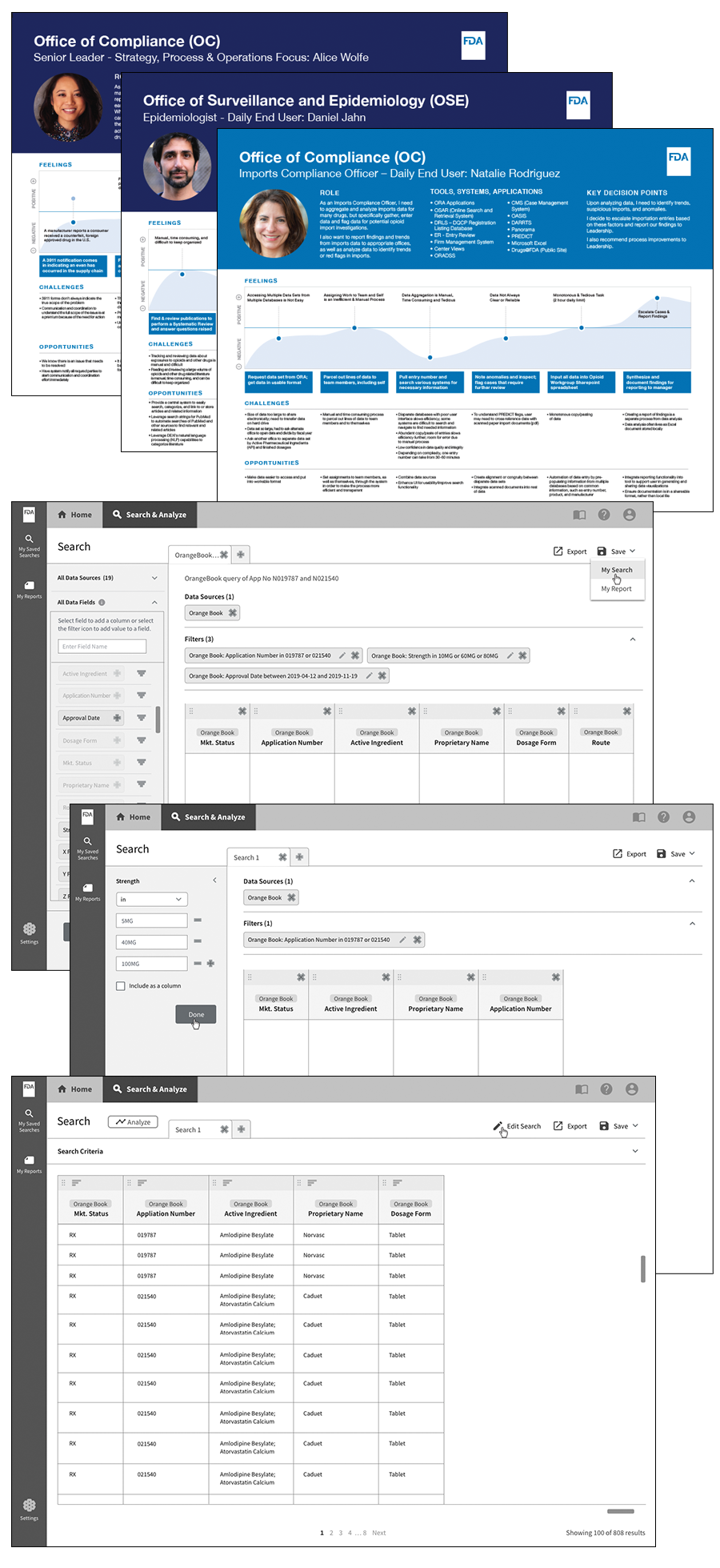
Opioid Data Warehouse images

My Role: HCD Lead

Challenge

As nationwide opioid abuse hit epidemic levels, government officials began battling the crisis primarily from a reactionary standpoint, stepping in after the fact to treat victims, identify causes, and find solutions. In order to stem the tide of the crisis, agencies like FDA needed to find ways to be more proactive in preventing abuse by looking at real-time data across multiple sources to look for patterns and trends that could save lives.

Solution

Working across multiple FDA offices with epidemiologists, import compliance officers, and scientific modeling experts, a large team of designers, developers, and data scientists built the FDA Opioid Data Warehouse (ODW), a platform to ingest data from multiple sources, combine and filter that data, and model outcomes to help prevent further outbreaks. The HCD team interviewed over 30 FDA staff representing various roles, captured their needs through personas and journey maps, and translated those needs into specific requirements to build an intuitive, easy-to-use system that could scale with the needs of the organization and the country.

Impact/Results

Transition from Spreadsheets to Platform
Epidemiologists and modelers had been using manual methods of capturing and managing data, much of which wasn’t timely enough for effective action. The ODW platform provided a single, sharable source of current data for easier synthesis.

Leveraging Data for Focused Prevention
The ability to combine data like drug import records, hospital/ER admissions, and abuse recovery programs helped identify “hot spots” of abuse and deploy personnel from local and national organizations for better treatment and prevention.

Tracking Measurable Results
From the height of the opioid epidemic in 2017 to 2023, drug overdose deaths involving prescription opioids fell from 17,029 to 13,026. This was a combination of efforts that included public awareness and education, treatment, and stricter access, and ODW was a critical, data-driven part of the solution.


Case Study: FDA Purple Book

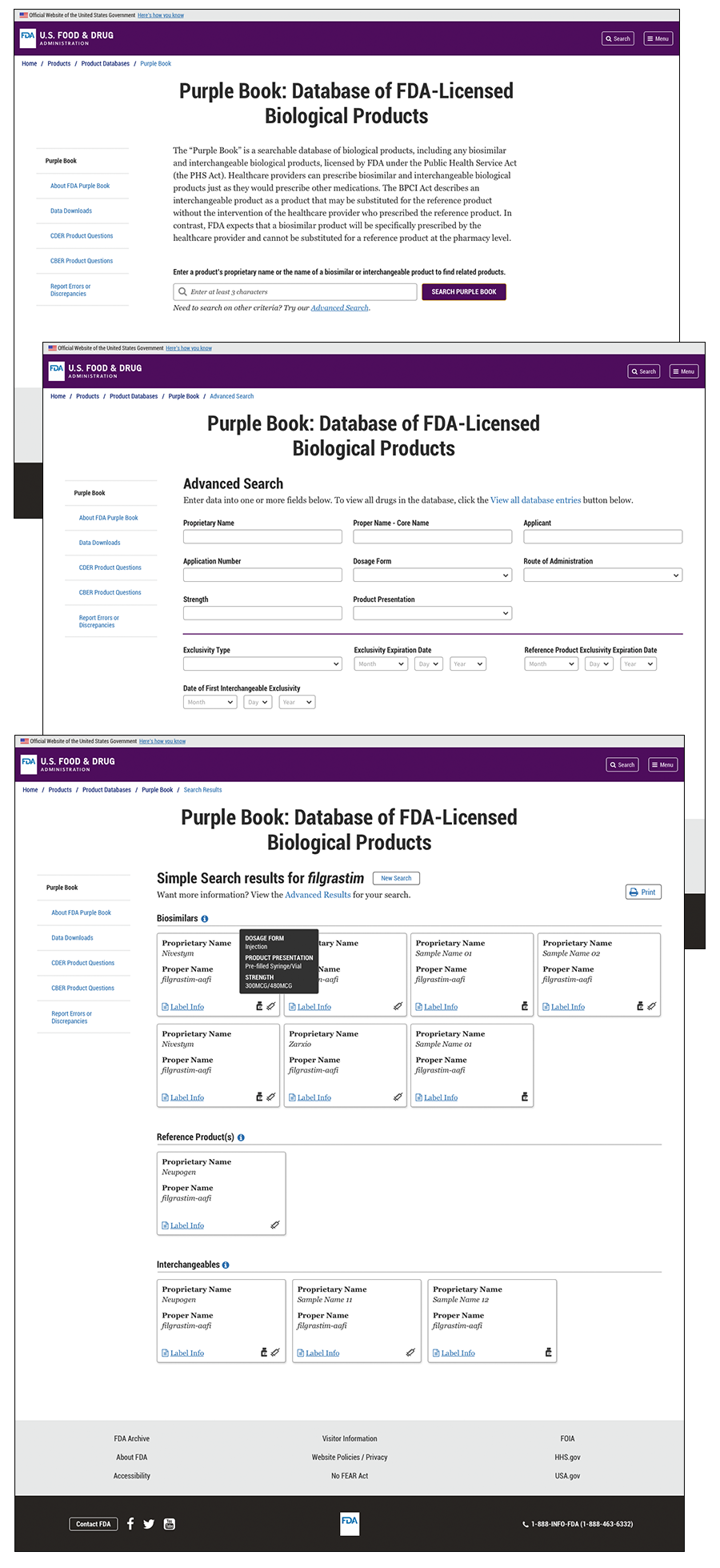
Case Study Image

My Role: Senior/Lead Designer

Challenge

The Purple Book is a database of FDA-licensed biological products, including their licensed biosimilar and interchangeable products, and their reference products. The information was available in tabular data format, but the limited search capabilities and technical details made it difficult for multiple user groups to find the information they needed.

Solution

Working with users and stakeholders from the Center for Drug Evaluation and Research (CDER), we reimagined search and results required for three distinct user groups: patients and the general public; healthcare providers; and manufacturers and researchers. Options for both simple and advanced searches allow for granularity when needed, and results, grouped by drug type (biosimilars, reference products, and interchangeables), provide visual or tabular results with relevant information.

Impact/Results

Insight for Patients and the General Public
‘Simple Search’ provides information about a biological product patients are currently taking or may be prescribed, as well as options for FDA-approved biosimilar and interchangeable products, potentially helping reduce risk and manage drug costs.

Options for Healthcare Professionals
Doctors and other providers can see all associated products for a biological product they prescribe or are considering prescribing for a patient, including biosimilars and interchangeable products. With Advanced Search, providers can search using additional terms, including strength, dosage forms, or product presentations.

Clarity for Manufacturers and Researchers
Important information like approval timelines, competing products, and exclusivity dates can help manufacturers plan for future research and development efforts. Advanced Search parameters can provide tabular data that can be downloaded as an Excel, CSV, or PDF file for offline research.